
When I first came to Bolivia, I was excited because I know it to be one of the few nations to officially recognize indigenous communities, their territories and governmental autonomy, as well as pre-existing rights. 36 of them are officially recognized in Bolivia’s constitution. You would think with so much diversity, division and subdivision, territories, identities, and languages, there would be much divisiveness, but that is not the case.

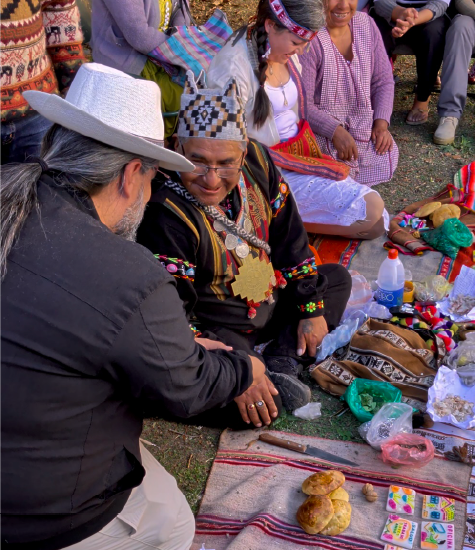
Leonel Cerruto, director of Kawsay, leads the preparation of a k’oa at the inauguration of Turismo Biocomunitario
There’s an ethos that unifies all of them. Leonel Cerruto, the director of Kawsay, a center for the promotion of indigenous cultures where I serve as part of my ministry, speaking at a recent encuentro of the various communities, said “there is no culture without territory, no territory without culture.” There is an intimate link between land and ways of life. Relationship to plants and animals, the seasons, dress, climate — these are all related. That link to the land undergirds the distinctiveness of each community and region.
The people of the Andean highlands have a cosmology that understands reality in three planes: hanan pacha — the heavens, kay pacha — the surface world, urkuh pacha — the underworld. Pacha is not a sterile scientific way of looking at the world. There is a connection to time and space as well as life and death that is deeply personal. Our lives play out in kay pacha, but we are informed by our community members who have passed on in urkuh pacha, and our potential is manifested in the spirit of transcendence above in hanan pacha.
Relating to the world is a matter of personal affection; the term Pachamama translates to mother earth. And that relation is taken seriously. I hear people speak of her sweetly, what she likes, what hurts her. It is rare to see an Andean person take a sip to drink before first pouring a bit on the ground (challar), libation to the Pachamama. There is an often forgotten plane, Hawa Pacha — the infinite, the unknown, that which extends beyond human comprehension and dwells in mystery. This way of relating to the world contains wisdom, but not limitless wisdom. There is also humility. It recognizes there are things we don’t know and some we can’t know.

Ray presents a misterio to the Aymara yatiri, ahead of k’oa to Pachamama.
Just as it makes perfect sense for one bird to be bright and colorful and another to be camouflaged, it makes sense to have diversity among indigenous cultures. Ways of life and even physical attributes are modes of harmonious living and connection to diverse environments. The unifying principle is that each difference is based on an intimate link to the place from which it emerges. The cosmology of pacha places us — humans and human life — snugly at the center of a web of interrelations. Not, as many Westerners presume, man standing over and above a static thing called nature, not in a relationship of domination, but in a reciprocal relationship (ayni) within a dynamic web of interrelations that sustain every form of life.
My own ethnic and cultural background as Mexican-American with Raramuri lineage and other unknown indigenous ancestors mostly from northern Mexico, gives me a sense of connection to place. But like a majority of Mexicans, I have been detribalized by Colonial and post-colonial practices of erasure. Nevertheless, my ministry here in Bolivia, though a continent away from my homeland, has helped me reconnect with my own roots. I have found a connection to that unifying principle in myself and my heritage. In my ministry of accompaniment with indigenous communities of Bolivia, in their efforts to preserve their cultures I have found some healing of my own.

Cuando llegué a Bolivia, me emocioné porque sabía que era una de las pocas naciones que reconoce oficialmente a las comunidades indígenas, sus territorios y autonomía gubernamental, así como sus derechos preexistentes. 36 de ellas están reconocidas oficialmente en la Constitución boliviana. Uno pensaría que con tanta diversidad, división y subdivisión, territorios, identidades e idiomas, habría mucha división, pero no es así.
Leonel Cerruto, director of Kawsay, leads the preparation of a k’oa at the inauguration of Turismo Biocomunitario
Hay un espíritu que los unifica a todos. Leonel Cerruto, director de Kawsay, un centro para la promoción de las culturas originarias donde presto mis servicios como parte de mi ministerio, hablando en un encuentro reciente de las comunidades, dijo: «No hay cultura sin territorio, ni territorio sin cultura». Existe un vínculo íntimo entre la tierra y las formas de vida. La relación con las plantas y los animales, las estaciones, la vestimenta, el clima: todo está interrelacionado. Ese vínculo con la tierra imparte la singularidad de cada comunidad y región.
Los habitantes del Altiplano andino tienen una cosmología que percibe la realidad en tres planos:Hanan Pacha—los cielos, Kay Pacha—el mundo de la superficie, Urkuh pacha—el inframundo. No es una forma científica y estéril de ver el mundo. Hay una conexión con el tiempo y el espacio, así como con la vida y la muerte, que es profundamente personal. Nuestras vidas se desarrollan en Kay Pacha, pero somos extension de la vida de nuestros comunarios que han fallecido en urkuh pacha, y nuestro potencial se manifiesta en el espíritu de trascendencia de arriba en Hanan Pacha. Relacionarse con el mundo es una cuestión de afecto personal; el término Pachamama se traduce como madre tierra. Y esa relación se toma en serio. Oigo a la gente hablar de ella con dulzura, de lo que le gusta, de lo que le duele. Es raro ver a una persona andina tomar un sorbo para beber antes de derramar un poco en la tierra (challar), libación a la Pachamama. Hay un plano de existencia a menudo olvidado, Hawa Pacha—lo infinito, lo desconocido, aquello que trasciende la comprensión humana y reside en el misterio. Esta forma de relacionarse con el mundo contiene sabiduría, pero no una sabiduría sin límites. También implica humildad. Reconoce que hay cosas que faltan conocer y otras que no podemos conocer.
Ray presents a misterio to the Aymara yatiri, ahead of k’oa to Pachamama.
Así como tiene sentido que un ave sea brillante y colorida y otra esté camuflada, también tiene sentido que exista diversidad entre las culturas indígenas. Las formas de vida e incluso los atributos físicos son modos de convivencia armoniosa y conexión con diversos entornos. El principio unificador es que cada diferencia se basa en un vínculo íntimo con el lugar del que surge. La cosmología de pachá nos sitúa—a los seres humanos y a la vida humana—cómodamente en el centro de una red de interrelaciones. No, como muchos occidentales suponen, el hombre situado por encima de una cosa estática llamada naturaleza, no en una relación de dominación, sino en una relación recíproca (ayni) dentro de una red dinámica de interrelaciones que sustentan todas las formas de vida.
Mi origen étnico y cultural como mexicano-estadounidense con ascendencia rarámuri y otros ancestros indígenas desconocidos, principalmente del norte de México, me da un profundo sentido de pertenencia a mi tierra. Sin embargo, al igual que la mayoría de los mexicanos, he sufrido la destribalización provocada por las prácticas coloniales y poscoloniales de asimilación y borradura cultural. No obstante, mi ministerio aquí en Bolivia, aunque a un continente de distancia de mi tierra natal, me ha ayudado a reconectar con mis raíces. He encontrado una conexión con ese principio unificador en mí mismo y en mi herencia. En mi ministerio de acompañamiento a las comunidades indígenas de Bolivia, en sus esfuerzos por preservar sus culturas, he encontrado también mi propia sanación.
Please consider supporting my mission work in Bolivia with a donation through the link below.
I invite you to walk with me as a “COMPANION IN MISSION.” Companions in Mission are friends and generous donors who give financial gifts on a regular (usually monthly) basis. For more information, visit Become a Companion in Mission. Thank you so much for your generosity!